
The overall characteristics of a rock unit that reflect its origin and differentiate the unit from others around it. Mineralogy and sedimentary source, fossil content, sedimentary structures and texture distinguish one facies from another. – SLB Energy Glossary
In medical contexts, a facies is a distinctive facial expression or appearance associated with a specific medical condition. The term comes from Latin for “face” – Wikipedia
Generally, geologists distinguish facies by the aspect of the rock or sediment being studied. Facies based on petrological characters (such as grain size and mineralogy) are called lithofacies, whereas facies based on fossil content are called biofacies – Wikipedia
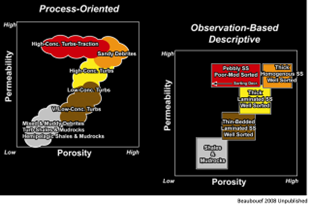
Reservoir Characterization
The characteristics of a rock unit that reflect its origin and permit its differentiation from other rock units around it.
Facies usually are characterized using all the geological characteristics known for that rock unit. In reservoir characterization and reservoir simulation, the facies properties that are most important are the petrophysical characteristics that control the fluid behavior in the facies.
Electrofacies and other multivariate techniques are often used to determine these characteristics. Rock types rather than facies are more likely to be used in reservoir simulation.
– SLB Energy Glossary
