
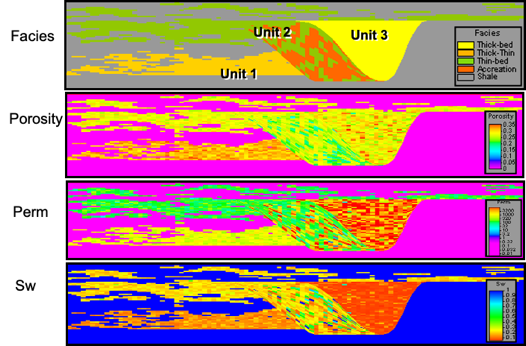
Recent production performance information from the study area in offshore Equatorial Guinea, indicates the presence of sub-seismic reservoir baffles and barriers. To address the issue of sub-seismic reservoir heterogeneity and compartmentalization we have turned to outcrop-based modeling applications. The Beacon Channel (Brushy Canyon) outcrop offers exceptional 3D views of a sinuous slope channel-fill. The scale and geometry of Beacon Channel is analogous to the smallest-scale stratigraphic features resolved by 3D seismic images of West African slope channel complex systems. Therefore, detailed analysis of Beacon Channel can potentially provide information regarding reservoir distribution and heterogeneity at a sub-seismic scale. A high-resolution, fine-scale 3D geocellular model was generated incorporating geometries and facies architecture observed in the Beacon Channel outcrop, along with rock and fluid properties based on subsurface reservoirs.
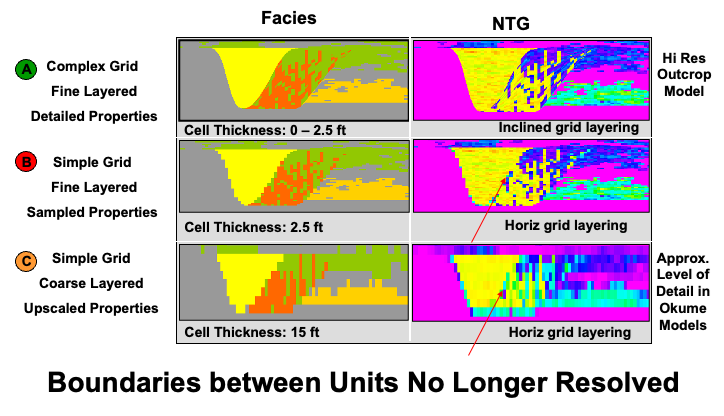
This model was subjected to fluid-flow simulation for baseline behavior. Next, the outcrop-based model was resampled / upscaled and new models were generated and subjected to fluid-flow simulation. The dynamic behavior of outcrop-based model and upscaled counterparts were compared to determine the appropriate level of detail required in the simulation model to retain characteristics modeled directly from the outcrop. Initial results indicate, as expected, simulations from the coarse, upscaled models reveal differences from the baseline behavior. More importantly, we find that baffle and barrier placement have a far greater impact on the dynamic performance of the reservoir than the inclusion or retention of the fine-scale depositional detail.
In other words, the placement of, sub-seismic, non-reservoir elements within the models have a greater impact on fluid flow than does inclusion of the high-resolution stratigraphic architecture of the reservoir elements. Future work needs to focus on improved ways to understand the probability and location of associated baffles or barriers for various depositional elements and the geocellular modeling workflows that best reproduce these characteristics.
