
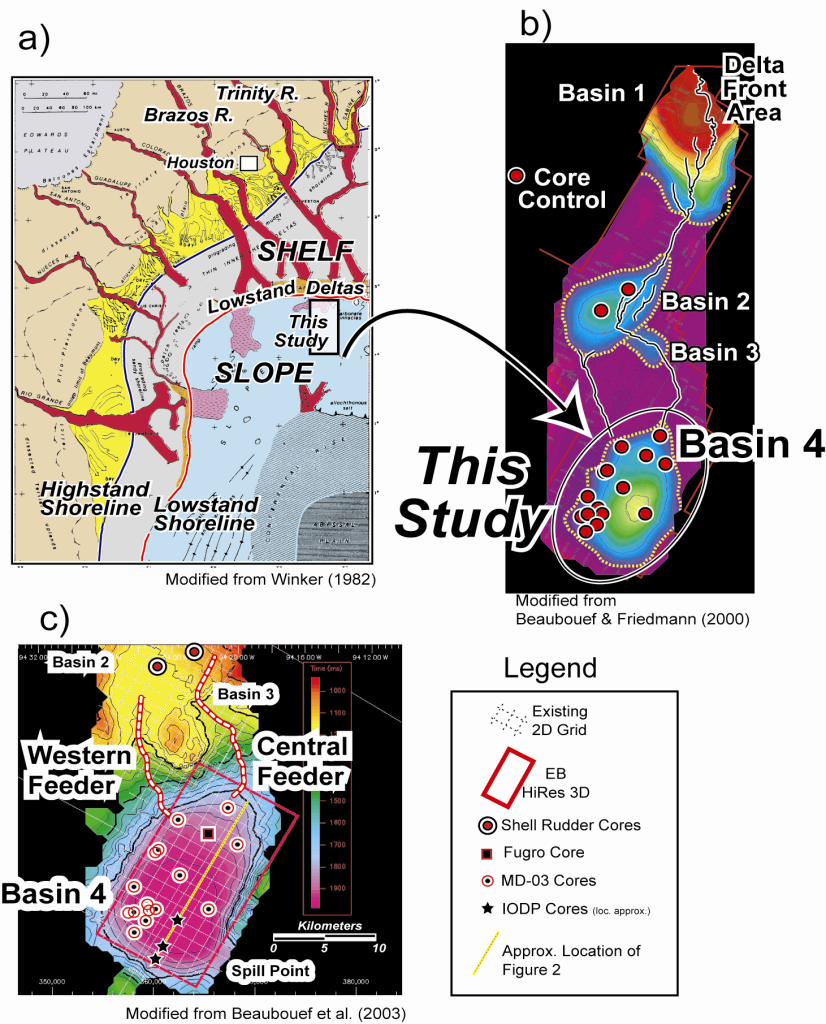
Understanding of deep-water reservoirs within the petroleum industry have primarily relied on interpretation of subsurface systems with conventional exploration data (deep seismic, well logs, cores) and descriptions of outcrops of ancient systems as analogs. More recently, data from late Pleistocene systems are being used in industry as analogs for subsurface reservoirs. The late Pleistocene Brazos-Trinity Slope System in the western Gulf of Mexico is one such example. This system has been investigated by numerous workers (Winker; 1998, Beaubouef and Friedman; 2000, Badalini et al; 2000 Beaubouef et. al; 2003, Beaubouef et. al 2004. Mallorino et. al; 2006 and others). This system is located basinward of the ancestral Brazos and Trinity rivers and their associated deltas. These shelf systems represent the source of sediment delivered to this portion of the slope. The setting is of particular interest because it provides a rare opportunity to study a complete deep-water depositional system from the shelf edge systems that fed it to its termination within the continental slope. Basin 4 represents the termination of that system. Beaubouef et. al 2003 and Mallorino et. al 2006 focused on the stratigraphy and basin fill history of Basin 4 using a short-offset, ultra-high resolution 3D survey and giant piston cores. Additionally, Basin 4 was investigated in a recent expedition of the Integrated Ocean Drilling Program (IODP) and coring of three long boreholes was completed.
The high resolution imaging of the fill of Basin 4 provided by the HR3D survey combined with the chonostratigraphic information provided by the cores, allows us examine the characteristics of these falling stage and lowstand deep-water deposits and refine the basin-filling model of Beaubouef and Friedman (2000). There are important differences between the high-amplitude, sand-rich units in Basin 4. Their deposition resulted from the complex inter-play between several variables including turbidity current size and velocity, grain size populations within the currents, and the slope of surfaces across which they passed. On one hand, the observed stratigraphic differences within Basin 4 may reflect the modulation of turbidity current behavior by the slope bathymetry. The nature of turbidity currents reaching Basin 4 may have been significantly impacted by grain size partitioning and/or flow stripping within up-slope basins. Alternatively, changes in depositional patterns within Basin 4 may have simply resulting from the progressive shallowing of the basin floor relative to the elevation of the inlet channel. Finally, changes in the nature of turbidity currents entering the basin through time may reflect a sequence stratigraphic control. In other words, temporal changes in the characteristics of flows reaching Basin 4 may have been related to evolution of the sediment supply “conveyor belt” during the late Pleistocene stepped sea-level fall. Regardless of the causal mechanisms, the evolution of Basin 4 imposed a stratigraphic trend resulting in deposits of differing reservoir geometry and continuity that are important to consider in deep-water field development and production settings.
