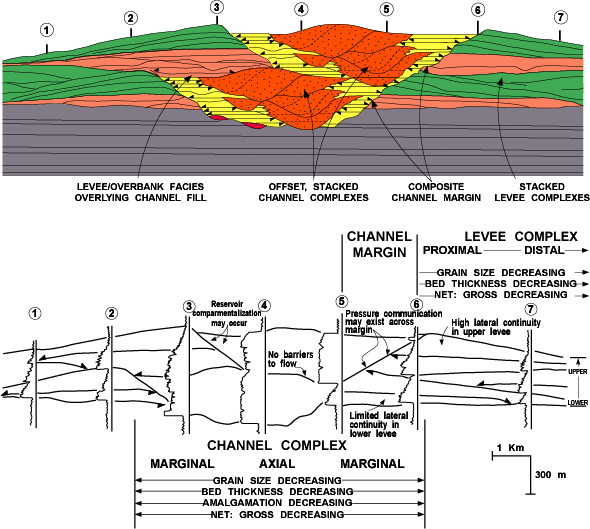
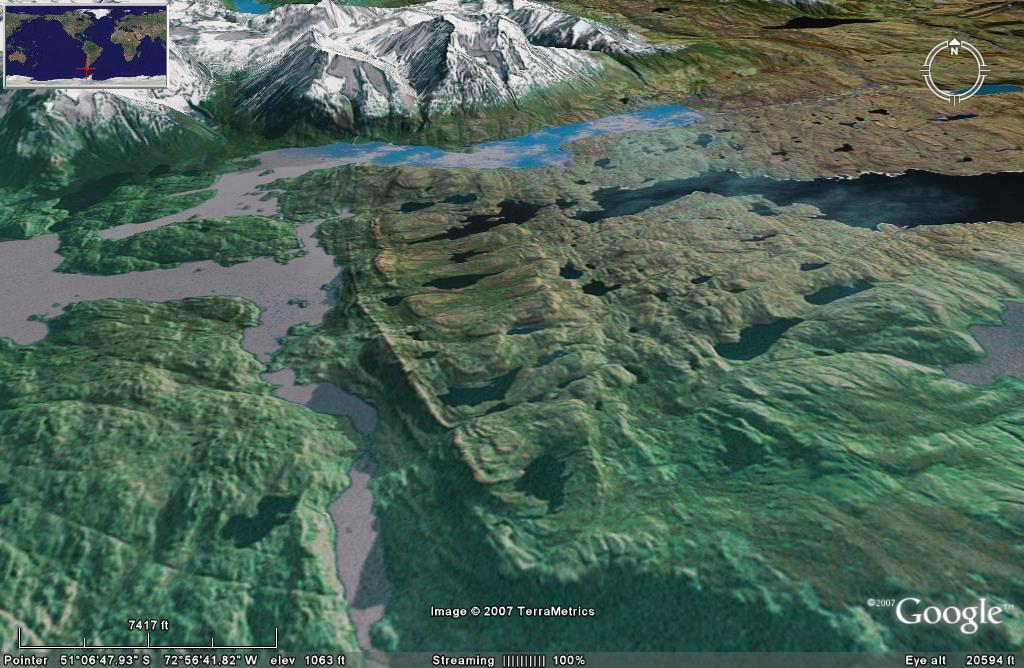
The Cerro Toro Formation within southern Chile contains a series of deep-water channel complexes deposited within an elongate Andean foreland basin during the Late Cretaceous (Beaubouef 2004; SPODDS Consortium-reports). The channels are filled by the deposits of high-concentration turbidity currents, and debris flows. Channel axes to margin facies changes between clast-supported conglomerate and either; (a) thick-bedded sandstone or (b) matrix-supported conglomerate are observed. Channel-fill facies lie on erosional surfaces that cut into adjacent inter-channel facies. Beds thin and onlap these surfaces toward the channel margins. Shale or siltstone drapes of the channel cuts are uncommon and laterally discontinuous. Bed continuity between channel and inter-channel facies is not observed, but sand-on-sand erosional contacts are common. The inter-channel strata are thinly bedded sandstone and shale facies interpreted to represent levee successions that bound the channels. Useful sedimentologic and stratigraphic analogies can be drawn for subsurface deep-water systems such as the Cretaceous-aged confined slope channel systems reservoirs of offshore Equatorial Guinea. In particular, these analogies may provide some clues about the reservoir characteristics and production performance of channel-fill and associated overbank reservoirs. The first-order controls on channel and inter-channel connectivity are the stacking pattern arrangements and facies juxtapositions resulting from the depositional history of the channel-complexes. The primary stratigraphic controls on potential pressure communication and fluid mobility between the channel and interchannel strata are the large differences in effective permeability of units in contact with one another across complex channel margins and the transmissibility of channel-margin zones. Amalgamated channel-complex axes, with high x-axis continuity and good Kz, will generally form zones of preferential fluid movement along the trend of the channel-complex set during production. The inter-channel reservoirs would be depleted at a much lower rate than the channel-fill units. Thus, the potential for stranded or bypassed hydrocarbon in these facies is high.