
As discussed in Seminar 2, the Brushy Canyon Formation of West Texas and New Mexico is one of the world’s premier outcrops for deep-water systems and has been studied extensively by industry and academia (e.g. Hess-supported Slope-Basin Consortium). It represents over 400 meters (1300 ft.) of Permian sandstones and siltstones deposited in an intra-cratonic, marine basin. Outcrops along the escarpments of the Guadalupe and Delaware Mountains provide a unique, oblique dip section through this ancient basin, providing for the study of deep-water depositional systems. This study provides a detailed view of the fill of a single, sinuous slope channel and offers some clues for deep-water reservoir characterization in development and production settings, including but not limited to, the distribution of very thinly bedded sandstones (“hidden pay”).
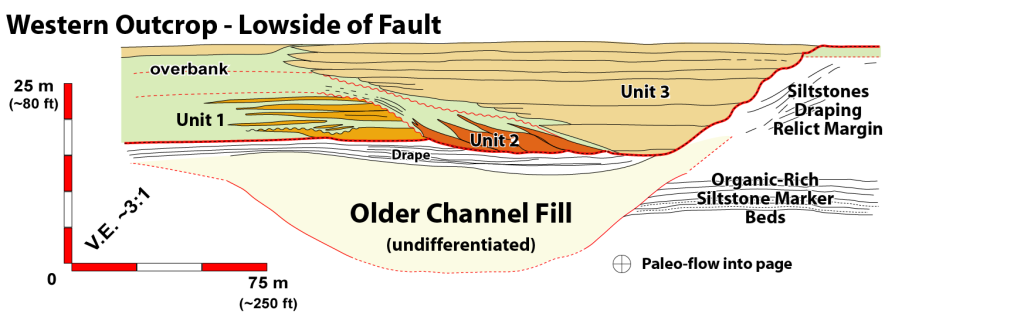
Beacon Channel is a recently characterized Brushy Canyon outcrop that offers exceptional 3D views of a sinuous slope channel-fill offset by a high angle normal fault (Beaubouef et al, 2007, Pyles et al in press). Reconstruction of the channel-fill through field mapping and Lidar (light detection and ranging) imaging reveals a sinuous plan-form pattern that can be traced over a distance of approximately 1.5 km (0.9 mi.) in the stream-wise direction. The channel-fill is approximately 200 m (660 ft.) wide and 15 m (49 ft.) thick and contains thickly-bedded, medium- to fine-grained sandstones. It is flanked by extensive, thinly bedded, fine-grained facies that can be traced for 1-2 km away from the channel-fill. The cross-sectional profile of the channel is asymmetric and hanging-wall and foot-wall exposures exhibit opposing cut-bank to inner bend relationships.
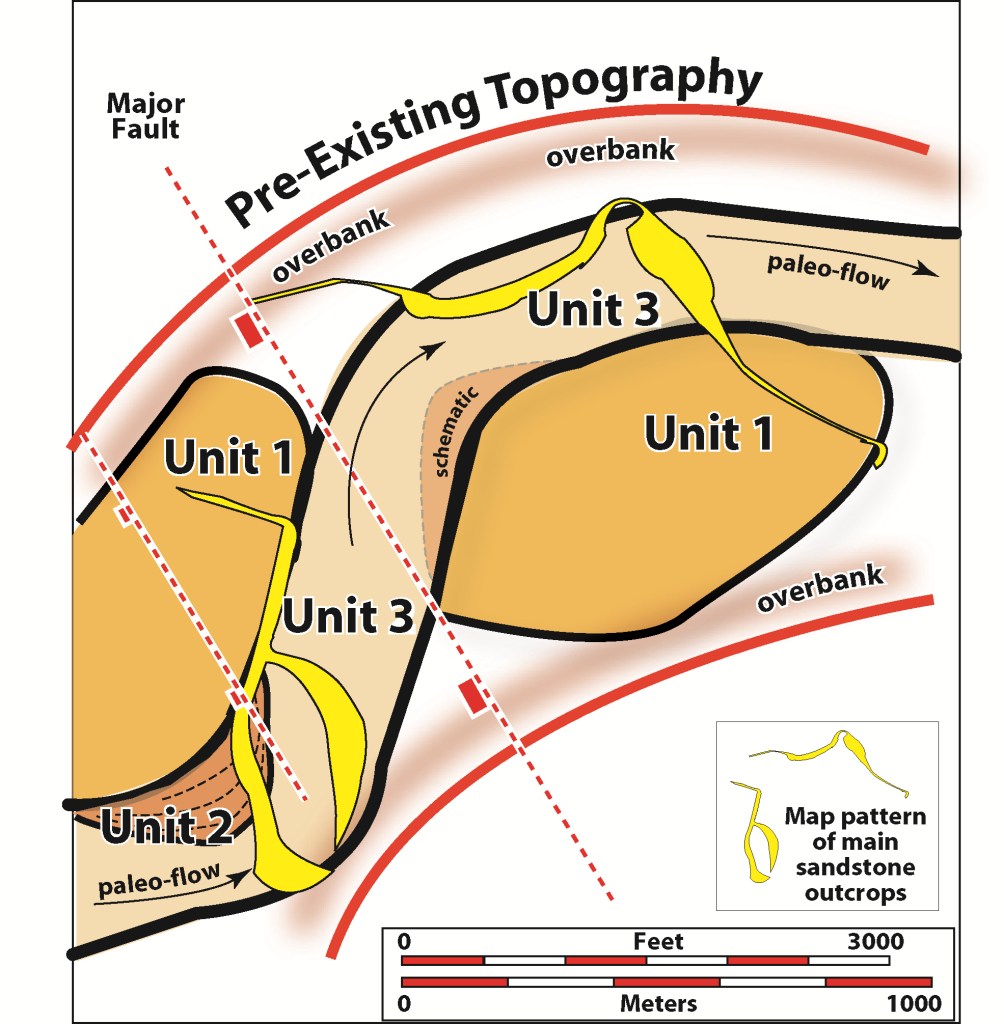
Importantly, the scale and geometry of Beacon Channel is analogous to the smallest-scale stratigraphic features resolved by high-resolution 3D seismic images of West African slope channel complex systems. Therefore, detailed analysis of Beacon Channel can potentially provide information regarding reservoir distribution and heterogeneity at a sub-seismic scale. This study also provides insights regarding the processes involved in the initiation, evolution and fill of sinuous, deep-water channels.
The stratigraphy of Beacon Channel outcrops reveals three distinct evolutionary stages. Each resulted in deposits of markedly different reservoir attributes;
- Unit 1) – a relatively unconfined stage of “lobe” deposition preceding channelization
- Unit 2) – a channelization stage associated with lateral channel migration and accretion of bar-like elements (LAP) in the inner bends, and
- Unit 3) – a “plugging” stage of channel-fill involving rapid aggradation of the final channel thalweg.
