
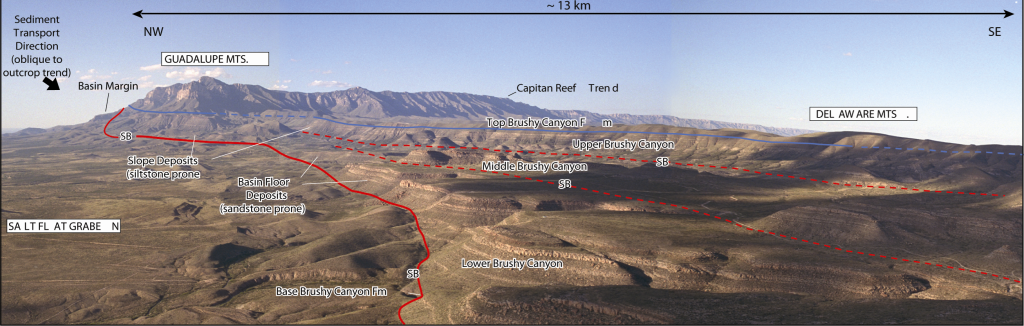
The Permian (Guadalupian) Brushy Canyon Formation consists of 460m of deep-water sandstones and siltstones that onlap older carbonate basin margin deposits at the NW margin of the Delaware Basin. The formation is exceptionally exposed along a 40 km outcrop belt in the Guadalupe and Delaware Mountains, west Texas. The outcrop belt forms an oblique-dip transect from the slope to basin floor which enables analysis of variations in channel styles and sandstone-body architecture across the depositional profile (Zelt and Rossen, 1995; Beaubouef et al., 1999, Gardner and Borer, 2000, Gardner et al., 2003). Brushy Canyon siliciclastic deposits form a 3rd order lowstand sequence set which can be subdivided into at least 3 high frequency sequences. Each sequence contains a lowstand fan systems tract (composed of laterally extensive, sandstone-prone fans on the basin floor, and large, sandstone-filled channels encased in siltstones on the slope) and an abandonment interval (lowstand wedge to transgressive systems tract) composed of thin, laterally extensive siltstones. Progadational stacking patterns from the Lower to Upper Brushy Canyon members reflect evolution of the basin margin during Brushy Canyon time from a relict carbonate slope to a constructional, siltstone-dominated slope. This presentation provides an overview of representative examples of channel complexes deposited in interpreted middle-slope, toe-of-slope, and basin floor (transitional, channel to sheet) environments.
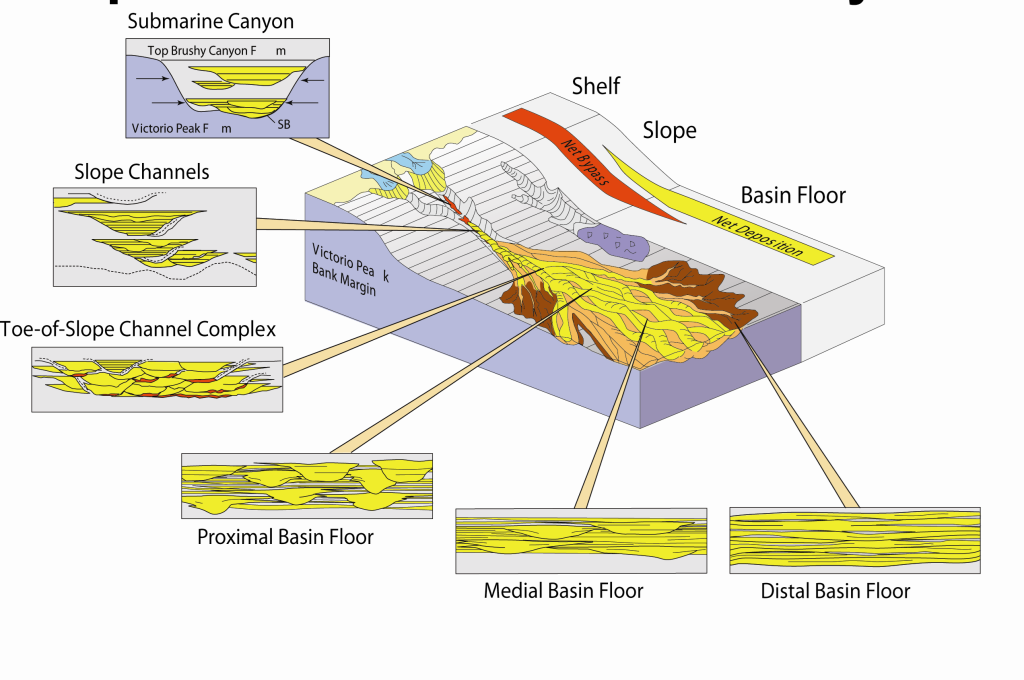
Slope to basin variations in architecture observed in the Brushy Canyon Formation reflect down-slope changes in gradient, degree of flow confinement, amount of erosion and sediment bypass, and relative timing of deposition from the basin-floor to the slope during a lowstand systems tract. Slope areas are characterized by thick, basinward-thinning wedges of laminated siltstones and channel-confined sandstones. Basin-floor areas are characterized by thinner siltstones and thick, laterally-extensive sandstone packages that are channelized internally.On the slope, major feeder channels are deeply incised into thick wedges of laminated siltstones.
Channel margins are complex and channel fill styles are variable reflecting the protracted sediment bypass histories and possible late-stage back-filling of these slope channels. Channels are vertically stacked as a result of proximity to up-dip canyons and influence of local topographic lows on the slope. At the toe of slope, sandstones occur in broader complexes of nested, compensationally-stacked channels. Channel bases are commonly marked by lenticular, coarse-grained lags deposited from high-energy, bypassing flows. Channel fills are complex and indicate repeated episodes of erosion, bypass, and backfill, with thick-bedded sandstones concentrated in channel axes and thin-bedded sandstones and siltstones preferentially preserved along channel margins.
In more aggradational basin floor areas (proximal to medial settings), channels are less deeply incised and are characterized by simple margins, scarcity of basal lags, and predominance of amalgamated, thick-bedded sandy turbidite fills. These channels are interpreted as relatively short-lived features plugged by rapid deposition from high-concentration turbidity current flows. Distal basin floor areas are characterized by tabular (sheet-like), medium- to thick-bedded massive sandstones that stack compensationally and that exhibit variable vertical amalgamation. These sand bodies reflect rapid deposition in an unconfined setting from high-concentration, sandy turbidity current flows.
