
High resolution 2D seismic, sidescan sonar images, and shallow penetration cores were used to study a portion of the upper to middle Texas continental slope. Within the study area are four intra-slope basins presently connected to one another via a network of submarine channels. The depositional setting occurs in water depths of 400 to1500 m and is located depositionally down-dip of Pleistocene fluvio-deltaic complexes. These shelf edge systems represent the source of sediment delivered to these intra-slope basins basins. The filling of these basins occurred very rapidly and with pronounced cyclicity, in less than 100 Ky during the late Pleistocene. Based on seismic stratigraphy and facies, the fill of these basins is interpreted to exhibit vertical cyclicity reflecting alternating deposition of mass transport complexes (MTC), distributary channel-lobe complexes (DLC), leveed-channel complexes (LCC), and hemipelagic drape complexes (DC).
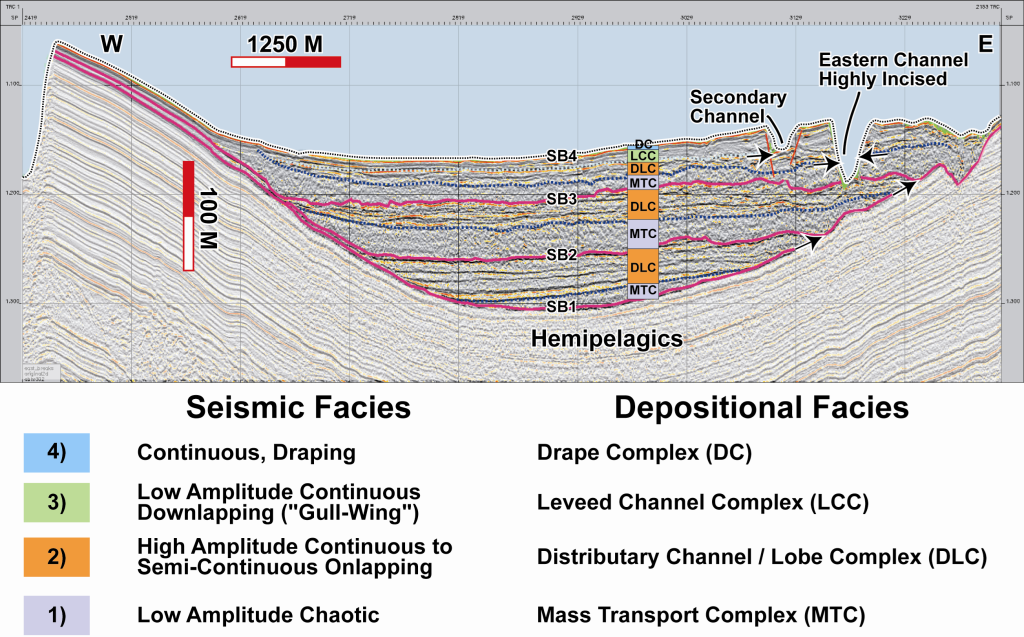
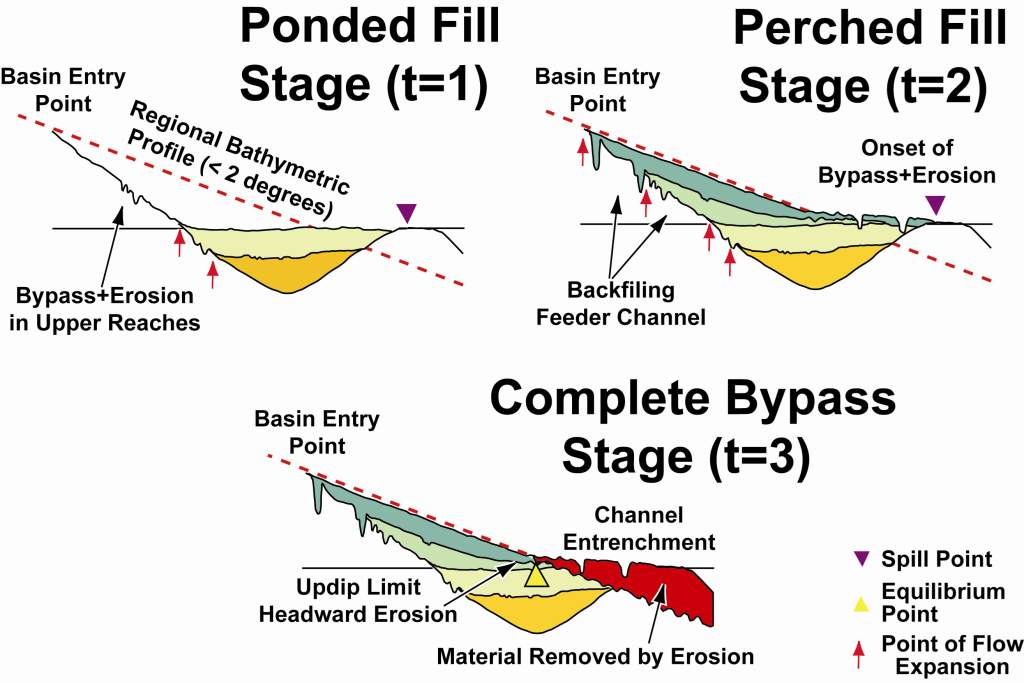
MTCs are low amplitude, chaotic seismic facies units interpreted as mud-rich complexes of slumps, slides, and debris flow deposits. The DLCs are sand-rich depositional units characterized by moderate to high reflection amplitude and continuity and exhibit fan shaped or distributary map patterns. LCCs are characterized by low amplitude, highly continuous reflection character and “gull-wing” cross-sectional profile and are considered to form from overbank deposition of low concentration turbidites and contain low to moderate sand percentages. DCs are thin, highly continuous seismic units that represent hemipelagic mudstones deposited during periods of abandonment and sediment starvation. Post-depositional processes have significantly modified these channels and the fill of the basins. Most notable among these processes are headward erosion and mass wasting. This erosional modification occurred in response to flow across local gradient changes along the system as individual basins were filled and subsequently bypassed by sediment gravity flows.
