
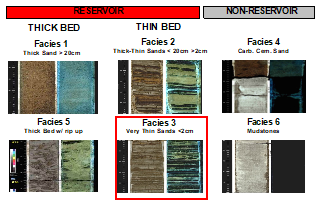
Reservoirs in the study area of offshore Equatorial Guinea, are comprised of high-quality, Cretaceous sands deposited in a submarine canyon setting. This canyon contains a variety of deposits including those associated with vertically stacked to laterally migrating leveed channel complexes. A spectrum of reservoir facies is observed in the area. Among these are very thinly bedded to laminated, turbidite sands (<2 cm) with abundant mudstone (Facies 3). Based on analysis of >1600 ft of conventional core, Facies 3 is the most common of the reservoir facies by a factor of 2-3. Because of its relatively high abundance and average porosity of 24-25%, Facies 3 contributes significantly to the OOIP (“storage”) of the field. However, due the relatively low NTG and low permeability, Facies 3 is a very minor contributor to accessible or “effective” OOIP and permeability thickness of the reservoir system (“deliverability”).
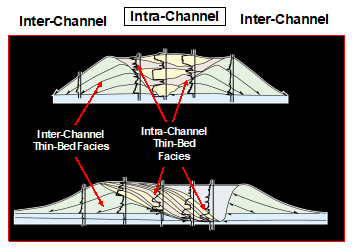
Hence, Facies 3 represents a dilemma to reservoir characterization and modeling. While important to hydrocarbon storage in the developed area, Facies 3 is minor contributor to well deliverability, and is very difficult to identify and model. Careful integration of seismic, electric logs, cores and production data reveals that not all Facies 3 reservoir intervals are the same. Facies 3 can be subdivided into intra-channel (3a) and inter-channel (3b) sub-facies. Sub-facies 3a occurs within the fills of channel complexes, while sub-facies 3b occur outside channel margins and are interpreted as levee/overbank strata. This presentation will review important distinctions between these different types of thin-bedded reservoirs in terms of reservoir architecture and performance.
