
The study are is an oil field in Green Canyon, Guilt of Mexico at approximately 3400 ft water depth. It was discovered in 2005 and 2006. The structural trap is a sub-salt 4-way anticline (“turtle” structure) with a crestal fault network. Reservoir depth range ranges from 28000 to 30000 TVDSS, and are Middle Miocene in age (Serravallian, 11.8-13.8 Mya). The reservoir are within a fine-grained, poorly sorted sandstone succession, deposited within an intra-slope, slat-withdrawal basin. Field development began in 2018 with the drilling of a series of crestal producer wells and peripheral water injector wells. Wells are completed in 3 intervals (from base to top, the Sh 20 (“Twins”), Gff40, and Gff10 biostratigraphic zones). The Gff40 was the main target of the development, having the largest in-place resource. This study documents the efforts to (re)characterize the Gff40 reservoirs following the initial phase of development.
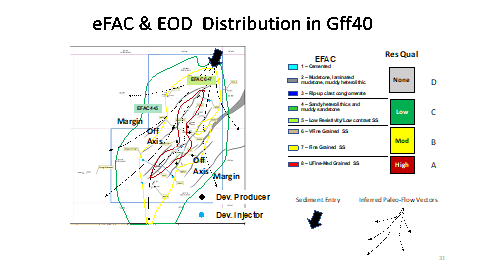
The objective was to develop a simple, practical, and repeatable reservoir facies scheme for the Gff40 interval that yields significant petrophysical distinctions for all wells and map the reservoir variability across the field to establish predictive depositional and petrophysical concepts that could be used as inputs for reservoir modeling. The reservoir facies prediction method was to use down-hole logs, conventional core and SWC information from a set of “control” wells to create a petrophysical reservoir facies model (eFAC model) that could be propagated to all (un-cored) wells. As part of this effort a standardization of petrographic analyses was accomplished, and legacy core descriptions were revisited.
The results established that:
- P-K-S relationships are primarily governed by depositional processes (grain size and sorting) with minor diagenetic overprint
- Permeability thickness (KH) is correlated with the assemblage of eFAC classes in the wells, and is thereby governed by lithofacies associations
- The distribution of eFAC classes and reservoir quality (RQ) follow a simple Axis to Off-Axis depositional pattern. There is a central, NNE-SSW oriented reservoir “sweet spot” that follows the Axis depositional environment and the crest of the structure
- The RQ of development wells falls within the range found by E&A wells, but at the lower end of the range, being primarily located in the Off-Axis environment
- Reservoirs show variable pressure connectivity between the Axis and Off-Axis environments
